
There's something quietly remarkable about watching a child find their footing on horseback for the very first time. The stillness that settles over them, the way their posture shifts from nervous to confident — it's the kind of moment families carry with them for years. If you've been searching for equestrian lessons for families in Liberty Hill, TX, you're likely after exactly that kind of experience: grounded, real, and lasting.
The Texas Hill Country is extraordinary riding country. Rolling terrain, cedar and live oak, open sky — it's a backdrop that makes every lesson feel like something more than a lesson. And right here near Liberty Hill, Liberty Hill Equestrian Experience (LHEE) has built a program specifically designed to meet families where they are — whether your child has never touched a horse or has been riding for years.
This guide covers everything you need to know before booking: what family equestrian programs actually include, how to evaluate a program's safety and quality, what age ranges are appropriate, and how LHEE structures its offerings to give every member of the family a meaningful experience.
Why Families Are Choosing Equestrian Programs in 2026
Interest in outdoor, screen-free activities for kids and families has grown sharply in recent years, and equestrian programs are among the biggest beneficiaries of that shift. Parents are looking for activities that build real skills — responsibility, emotional regulation, physical coordination — rather than passive entertainment.
Horse riding delivers on all of those fronts simultaneously. A child who is responsible for grooming a horse before a lesson is learning caretaking and empathy. A rider working on posting trot is developing core strength and balance. A young person who has to stay calm when a horse spooks is learning emotional self-management in a way that no classroom exercise can fully replicate.
- Physical development: Riding engages core muscles, improves posture, and builds full-body coordination.
- Emotional growth: Managing a prey animal that responds to your emotional state teaches self-regulation under gentle pressure.
- Responsibility: Horse care teaches consistent commitment — horses don't take days off, and neither does the learning.
- Confidence: Successfully communicating with a 1,000-pound animal builds a brand of self-trust that transfers to every other area of life.
- Family connection: When siblings or parents learn together, they build shared vocabulary and shared memories that strengthen bonds.
For families in Liberty Hill and the surrounding Hill Country communities — Leander, Georgetown, Cedar Park, Burnet — LHEE offers a local option that doesn't require driving into Austin traffic to find a quality program.
What to Look for in a Family Equestrian Program
Not all riding programs are created equal, and when you're enrolling children, the quality gap matters enormously. Here's what separates a genuinely excellent family equestrian experience from a simple trail-ride operation.
Qualified, Education-Minded Instructors
Look for instructors who have formal education credentials alongside their riding experience. LHEE is led by Aarica Fitch, a Masters Level Educator — that distinction matters because she understands developmental stages, learning styles, and how to sequence instruction so skills build on each other rather than being taught in isolation. A riding instructor who is also a trained educator structures lessons differently, and kids learn faster and more safely as a result.
Age-Appropriate Programming
Good programs don't treat a five-year-old and a twelve-year-old the same way. Look for offerings that segment by age and developmental readiness. LHEE's Little Riders Program is designed specifically for younger children who are just beginning to develop their relationship with horses, while Youth Horse Riding Lessons serve older kids with more structured riding instruction.
Horse Welfare Standards
The temperament and care of the horses matters as much as the instruction. Well-cared-for horses are calmer, more predictable, and safer for beginner riders. Ask any program you're considering about their horse care protocols, how many riders each horse sees per day, and what the turnout and rest schedule looks like.
Safety Infrastructure
Safe facilities include appropriate fencing, clean and well-maintained tack, helmets that fit properly, and clear protocols for what happens if a rider falls or a horse behaves unexpectedly. This isn't about fear — it's about preparedness.
Small Group Sizes or Private Options
Family programs that keep group sizes small give instructors the ability to correct form, manage energy levels, and keep every rider safe. When groups are too large, individual attention disappears and risk increases.
LHEE's Core Programs for Families
Liberty Hill Equestrian Experience has built a tiered program structure that can serve a family for years — not just a single season. Here's a look at the programs most relevant to families exploring equestrian lessons together.
Youth Horse Riding Lessons
The flagship program at LHEE, youth horse riding lessons cover the core disciplines of riding: seat, balance, rein communication, gait transitions, and safe mounting and dismounting. These aren't casual trail-ride-style sessions — they're structured lessons that progress as the rider progresses. For families wanting their child to develop genuine riding skill over time, this is the program to start with.
Little Riders Program
Younger children — typically ages four to seven — often need a gentler on-ramp to the equestrian world. The Little Riders Program is designed with that developmental stage in mind. Sessions focus on building comfort around horses, basic ground work, led riding, and the beginning of a horse-human relationship. The goal isn't to rush toward independent riding — it's to build a foundation of trust and confidence that makes future lessons easier and safer.
Horsemanship and Grooming Lessons
One of the things that separates equestrian education from simple riding instruction is the emphasis on the whole relationship between horse and human. Horsemanship and grooming lessons teach children how to care for their horse before and after riding: brushing, picking hooves, understanding body language, and reading a horse's mood and physical state. These skills build empathy, deepen the bond, and make children safer around horses in general.
Hill Country Weekend Excursion Packages
For families who want to combine riding with a broader outdoor experience, Hill Country weekend excursion packages offer a guided exploration of the beautiful terrain surrounding Liberty Hill. These packages are ideal for families visiting from Austin or further afield, or for local families who want a special outing that goes beyond a standard lesson format.
Summer Camps
LHEE's summer camps represent the most immersive family option on the calendar. Multi-day programs allow kids to live inside the equestrian world for an extended stretch — combining daily riding with horsemanship, barn responsibilities, nature exploration, and peer community. Summer camp alumni often return year after year, and many transition into the year-round lesson programs after their first camp experience.
How Family Equestrian Lessons Are Structured at LHEE
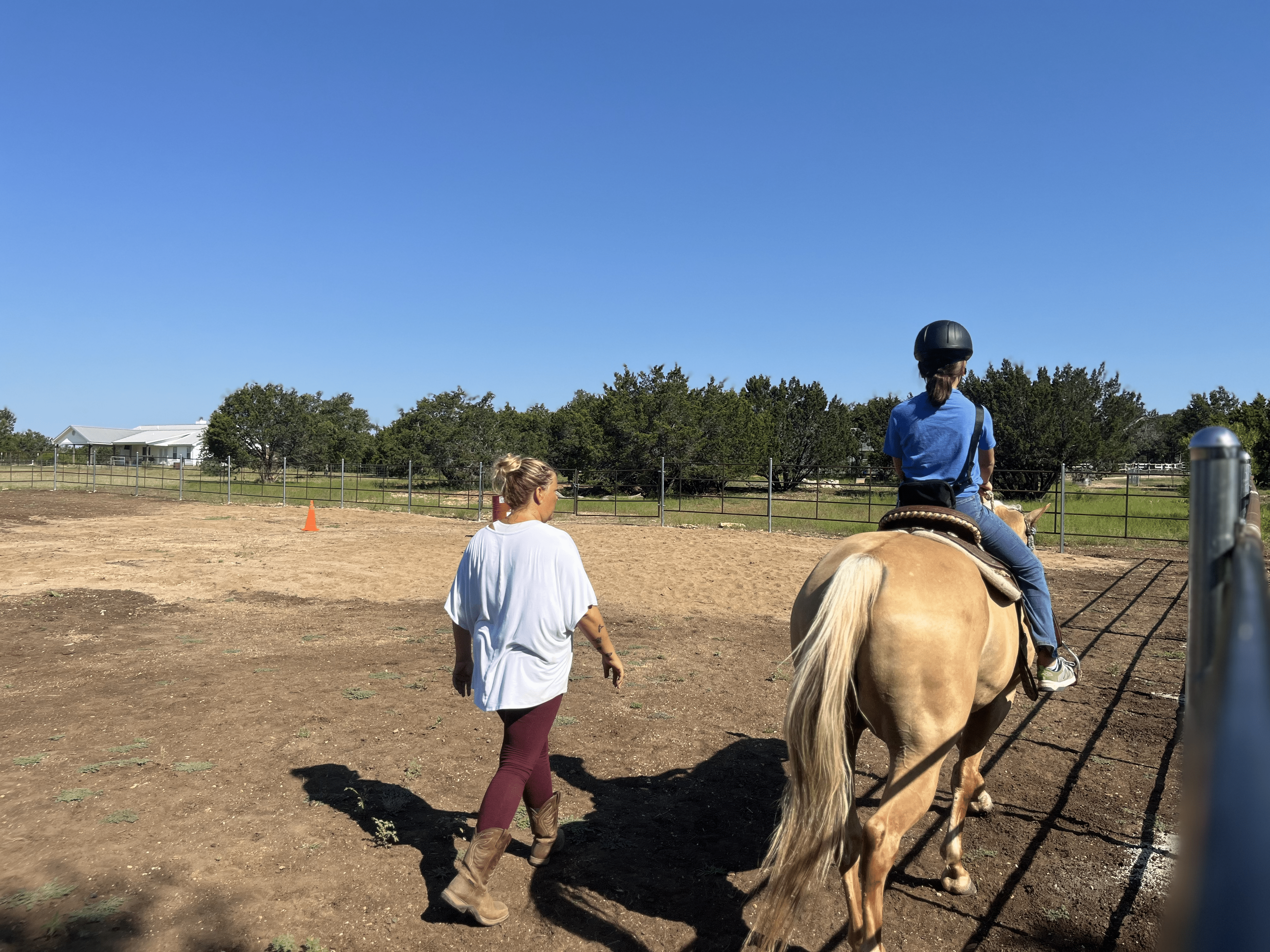
Understanding the format of lessons before you arrive helps families prepare and helps kids feel less anxious about the unknown. Here's a typical session flow for a youth riding lesson at LHEE.
Pre-Ride Groundwork (15–20 Minutes)
Before anyone mounts up, students are introduced to their horse for the day. They learn to approach calmly, halter the horse, lead it from the stall to the grooming area, and begin the grooming process. This phase isn't just preparation — it's instruction in itself. Students read the horse's body language, learn to move around the horse safely, and begin building a relationship that makes the riding phase smoother.
Tacking Up (10–15 Minutes)
Depending on the student's level, they may assist or lead the tacking-up process: placing the saddle pad, settling the saddle, adjusting the girth, and fitting the bridle. Older or more experienced students do more of this independently. Instructors use this time to check equipment and make sure every piece of tack is correctly fitted before any riding begins.
The Riding Lesson (30–40 Minutes)
The mounted portion covers whatever the student is working on at their current level. For beginners, that means basic position, the walk, and steering. For intermediate riders, it might include trotting with and without stirrups, lateral work, or beginning canter work. Instructors give real-time feedback and correct habits before they become ingrained.
Cool-Down and Horse Care (10–15 Minutes)
After dismounting, students untack, brush down, and return their horse to its stall or paddock. This is also the debrief moment — instructors summarize what went well and what to focus on before next time. For families watching from the fence, this is often the most touching part of the session.
Is Your Child Ready for Equestrian Lessons?
One of the most common questions parents ask is simply: is my child old enough? The short answer is that there's a wide range, and temperament matters as much as age. Here's a rough guide.
- Ages 4–6: Best suited to the Little Riders Program. Focus is on ground interaction, led riding, and comfort around horses. Not about independent riding yet.
- Ages 7–10: Ready for introductory youth riding lessons. Can begin to understand rein aids and simple gait transitions. Attention spans are long enough to absorb structured instruction.
- Ages 11–14: Ideal window for developing real riding skill. Physically coordinated and motivated enough to progress through the gaits and begin working on more nuanced communication with the horse.
- Ages 15+: Can work toward more advanced horsemanship, begin exploring different riding disciplines, and potentially assist younger riders in supervised contexts.
Children who are nervous around large animals do not need to wait until that nervousness disappears — good instructors work with that nervousness directly, and most children who start anxious become the most deeply bonded riders within a few sessions. The key is finding a program with instructors skilled enough to meet the child where they are.
What Parents Can Do During Lessons
Parents often ask whether they should stay or drop off. Both approaches work, and LHEE can accommodate either. However, there are a few things parents can do during sessions to maximize their child's progress.
- Watch quietly from the designated viewing area. Enthusiastic cheering can distract both the child and the horse. Calm, supportive presence is much more helpful.
- Resist the urge to coach from the fence. Conflicting instructions from two directions confuse young riders. Trust the instructor to direct the session.
- Ask questions at the end, not during. Instructors are tracking multiple things simultaneously during a lesson. Save your questions for the debrief.
- Reinforce the lesson vocabulary at home. If your child comes home talking about posting trot or inside leg, engage with that language. It reinforces learning.
- Consider taking an adult intro lesson yourself. There's no faster way to understand what your child is experiencing than to sit in the saddle yourself.
Safety Standards in Family Equestrian Programs
Safety in equestrian settings is a shared responsibility between the program, the instructor, the horse, and the rider. Here's what LHEE prioritizes to keep every session as safe as possible.
Helmet Policy
Every rider wears an ASTM/SEI-certified equestrian helmet during every mounted session. No exceptions. Helmets must fit correctly — not just sit on top of the head — and are checked before every lesson. Families are welcome to purchase their own helmet for hygiene and fit consistency; LHEE can advise on appropriate models for different age groups.
Horse Selection and Matching
Not every horse is right for every rider, and good programs take matching seriously. Beginner and young riders are paired with horses that are calm, forgiving, and experienced with new learners. As a rider's skill and confidence grow, they may begin working with horses that offer more of a challenge.
Appropriate Footwear
All riders must wear boots with a heel — this prevents the foot from sliding through the stirrup, which is one of the most common causes of dragging injuries. Sneakers and sandals are never acceptable for mounted work. Families who don't own riding boots can typically get started with any boot that has at least a one-inch heel.
Instructor-to-Rider Ratio
Keeping group sizes manageable isn't just about learning quality — it's a core safety consideration. When an instructor is spread across too many riders, they can't respond quickly enough to developing situations. LHEE maintains small group sizes to ensure every rider has meaningful oversight throughout every session.
The Texas Hill Country Difference
Where you ride matters. The Texas Hill Country near Liberty Hill offers a natural setting that enhances the equestrian experience in ways that an indoor arena or flat suburban property simply can't match. Riding through cedar-lined trails, across open pasture, and along creek-fed terrain teaches horses and riders to navigate the real world together — not just a controlled rectangle.
For weekend excursion packages, the landscape becomes part of the curriculum. Riders learn to read terrain, adjust their balance on slopes, and maintain calm communication with their horse in a variety of natural environments. These are skills that stay with a rider for life.
The Hill Country also offers a quieter pace than Austin's urban fringe, which matters for horses and families alike. There's less ambient noise, less traffic stress, and more space — both physical and psychological — to slow down and actually connect with the experience.
Year-Round Programming vs. Seasonal Options
One practical consideration for families is scheduling. Equestrian programs often offer a mix of year-round enrollment and seasonal intensives, and choosing the right format depends on your family's goals.
Year-Round Lessons
For children who want to develop real riding skill, consistent weekly or biweekly lessons over twelve months produce dramatically better results than sporadic or seasonal involvement. Horses and riders both need repetition to build the muscle memory and trust that effective riding requires. Year-round youth horse riding lessons are the most direct path to genuine progress.
Summer Camp as an Intensive
For families who can't commit to weekly lessons during the school year, LHEE's summer camps provide a concentrated dose of equestrian education that can jump-start a child's skills and enthusiasm. Many camp participants become year-round students after experiencing the immersive format.
Weekend Excursions for Occasional Families
Families who want a meaningful equestrian experience without a recurring commitment will find the weekend excursion packages ideal. These guided experiences are designed to be complete in themselves — not a teaser for a sales funnel, but a genuine adventure that leaves every participant with a real experience of the Hill Country on horseback.
Horse Boarding at LHEE: For Families Who Want to Go Deeper
Some families reach a point where they're ready to invest more fully in the equestrian lifestyle — and that sometimes means owning or leasing a horse. LHEE's horse boarding services allow families to keep their horse in the same environment where their lessons take place, which dramatically simplifies the logistics and deepens the bond between child and horse.
Boarding at the facility where you train means the instructors know your horse, can monitor its health and temperament, and can tailor lessons to the specific pair — child and horse — rather than working with a new horse each session. For families seriously invested in their child's equestrian development, this is a meaningful upgrade.
Frequently Asked Questions About Equestrian Lessons for Families in Liberty Hill, TX
What is the minimum age for equestrian lessons at LHEE?
LHEE's Little Riders Program accepts children as young as four years old. These youngest riders participate in ground-based activities and led riding rather than independent mounted work, which is developmentally appropriate for their age. Children aged seven and up can typically begin structured youth riding lessons. If your child is younger than four and passionate about horses, reach out to discuss options — every child is different, and instructor assessment matters more than a strict age cutoff.
Do parents need to have any equestrian experience to enroll their child?
Not at all. The majority of families who enroll at LHEE are completely new to horses. Instructors explain everything parents need to know about what to wear, what to expect, and how to support their child's learning. You don't need to know anything about horses to give your child this experience — that's what the instructors are there for. Curious parents are always encouraged to ask questions and even consider trying a beginner session themselves.
How many lessons does it typically take before a child can ride independently?
This varies significantly by child and by how frequently they ride. Children who attend weekly lessons typically begin riding with light supervision rather than full instruction assistance within six to ten sessions. True independent riding — where the child is managing the horse fully without a lead line — generally takes three to six months of consistent weekly lessons for most beginners. Temperament, physical coordination, and the child's relationship with the specific horse all factor in. The goal is never to rush that progression.
What should my child wear to their first lesson?
Boots with at least a one-inch heel are required for all mounted activities — this is a genuine safety requirement, not just a style preference. Long pants are strongly recommended to prevent stirrup leather rubbing on bare legs. Helmets are provided by LHEE for new students, though families are welcome to purchase their own ASTM/SEI-certified equestrian helmet. Avoid loose clothing, dangling jewelry, or anything that could catch on tack or spook the horse. Comfortable, close-fitting layers work best for Hill Country weather variability.
Are the lessons suitable for children with special needs or sensory sensitivities?
Equestrian activities — particularly therapeutic and adaptive riding — have a well-documented positive impact on children with a wide range of developmental, sensory, and physical needs. LHEE's lead instructor Aarica Fitch holds a Masters Level Educator credential, which means she's trained to adapt instruction to different learning profiles. Families with children who have specific needs are strongly encouraged to discuss those needs directly before enrollment so the right program structure and horse matching can be arranged. Every child deserves an individualized approach.
How does the summer camp program differ from regular weekly lessons?
Summer camp is an immersive, multi-day experience that goes far beyond what weekly lessons can offer. Campers spend extended time at the barn each day — riding, doing horsemanship and grooming work, learning about horse care and health, and building community with other horse-loving kids. The concentrated format accelerates learning and builds peer relationships around a shared passion. Weekly lessons are the right format for consistent skill development during the school year; summer camp is the right format for a deep dive that transforms a child's relationship with horses in a short period.
Can families from outside Liberty Hill participate in LHEE programs?
Absolutely. LHEE serves families from across the greater Austin area, including Leander, Georgetown, Cedar Park, Round Rock, and communities throughout the Texas Hill Country. The facility is easily accessible from the Austin metro, and the Hill Country setting is a destination in itself. The weekend excursion packages in particular are popular with families visiting from further afield who want a memorable outdoor experience in one of Texas's most beautiful landscapes. Contact LHEE to discuss scheduling and directions when planning your visit.
Ready to Book Your Family's First Equestrian Lesson in Liberty Hill?
The Texas Hill Country is waiting, and the horses are ready. Whether your child is four years old and curious about the big animals they see from the car window, or twelve and ready to develop serious riding skill, Liberty Hill Equestrian Experience has a program built for them — and for your family as a whole.
LHEE is more than a riding school. It's a place where children build confidence, families build memories, and the relationship between a young rider and their horse becomes one of the most formative experiences of a childhood. Aarica Fitch and the LHEE team bring both deep equestrian knowledge and a genuine educator's heart to every single lesson.
Explore the full range of programs — from Little Riders to summer camps to weekend excursions — and reach out to get your family on the schedule. The best time to start is now.
For research on the developmental benefits of equestrian activities for children, the USDA National Agricultural Library's animal welfare resources offer a solid foundation, and PATH International — the Professional Association of Therapeutic Horsemanship — documents the wide-ranging cognitive and emotional benefits of horse-human interaction for young people. For safety standards and certification guidance, the ASTM International equestrian helmet standards are the benchmark every reputable program follows.